Because I am a Nike stockholder and general nerd, I listened to the Nike Q1 financial call. Before I get into the details, let me make something clear: I am a sneaker collector. I am not an expert on the footwear industry or even the sports apparel industry. I don’t know anything about what makes for a sound business strategy in the markets where Nike operates.
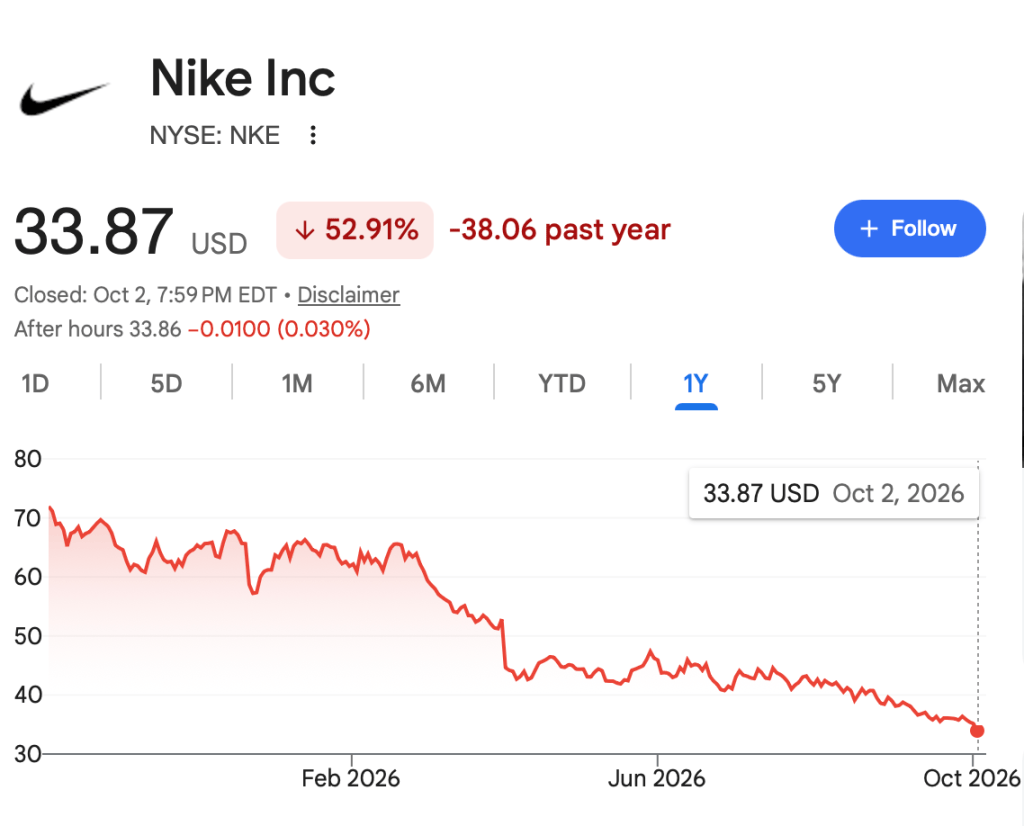
Still, I did listen intently to the call and picked up on a few themes that Nike’s CEO, Elliott Hill, and David Denton, Nike’s new CFO, talked about on the call. For those of you who don’t have the patience or interest in listening, here were the highlights:
- Sportswear—just under half of quarterly revenue—declined low double digits; Jordan declined mid teens; and Greater China fell 26%. Some weakness is deliberate: Nike cut Dunk revenue nearly 50% to reduce oversupply. But management also acknowledged disappointing sales of older footwear, excess inventory, weak lifestyle-market traffic, and heavy discounting in China.
- Nike’s focus on athletes and product innovation is producing measurable results, although performance growth is still too small to offset declines elsewhere.
- Nike plans to reduce Jordan retro supply, develop more differentiated Sportswear assortments, narrow China’s digital distribution, and improve retail experiences. Its “Pace” program adds supply-chain flexibility, fewer organizational layers, greater local decision-making, and an overall reduction in roles. Management targets approximately $2.5 billion in savings, with most expected in FY2029–2030.
With respect to Jordan Brand, which is what this post is about, there was one particular quote, from Elliott Hill, that I found to be the most interesting:
With Jordan Brand footwear, we’re going to get back to leading the scarcity model that we created. Simply put we’ve been oversupplying our iconic retro product asking them to do too much. And as we’ve done with the Air Jordan 1, we will deliberately reduce the volume and frequency of specific Jordan retro launches.
I totally understand why Nike would want to do this. It’s clear, from a collector and consumer perspective, that there are way too many retro Jordan releases. They aren’t special anymore and from a consumer perspective and there’s just too many to buy and consider buying. You can’t focus on the specialness of a particular release of there’s another release a few days later. It’s just not sustainable, especially in this economy where people are buying and spending less.
The other side of this argument is that the number of releases and the production volume of these release has made this a great time to be a sneakerhead and a collector. Almost everything is attainable at retail and for the releases that are less coveted, you can get them at a discount both from retailers and through traditional resale channels (like eBay, GOAT, or StockX). Having lived through the Jordan hype of 2020 and the years immediately before and after that, this is a really nice change.
When Nike says that they are going to cut the number of releases and artificially constrain the supply to make them more scarce, the dark reality of this is that there will be more fakes in the marketplace. There are already a lot of fakes on the market and we’re living in a time of Jordan abundance. Imagine what will happen with all that unmet demand when these sneakers become scarce again. There is already rampant backdooring and you can assume that this will continue, with product going directly into the hands of resellers who will mark up the product. Nike sees none of that value and by constraining supply, they create this secondary market that really sucks for consumers.
What I’d like to see: reduce the number of releases but keep supply at a level where releases are attainable. Improve the quality of the product through better materials (the insoles in the Air Jordan 1 are criminally bad) and QA. No one wants to get a limited Jordan with glue stains, misshaped panels, or botched stitching. Hold retailers and collaborators accountable for backdooring product – this includes Travis Scott. Finally, make an effort to stamp out replicas so that the pairs that end up in people’s hands are real product.
If you want to build a brand that connects with consumers, you have to create experiences for the consumer that are positive. Their strategy regarding Jordan Brand, while necessary, has a number of downsides that if not managed, will continue to push consumers to other brands.
###


Leave a Reply